


Let’s talk about risk
All investment products that do not have capital guaranteed include, in their features, a level of risk, as well as an expected return.
Risk and return
The risk level is an indicator that aims to show the probability of losses occurring in certain scenarios (which simulate market conditions from optimistic to pessimistic). In general, an investor seeking higher returns should know they will be exposed to products with higher risk levels. This investor should also understand that where there is risk, there can be losses, including losses of the invested capital.
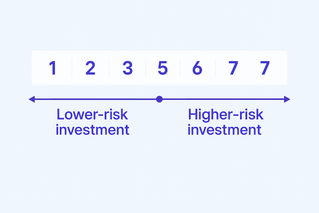
As an example, we present the Summary Risk and Reward Indicator (ISRR), used for investment funds.
This indicator measures the risk of price variation of participation units based on the volatility observed over a certain period of time, on a scale from 1 to 7. A lower risk level does not mean the product is risk free, as all funds can incur capital losses (total or partial).
In terms of a product’s ISRR, and recalling the target market, within the “risk tolerance” category:
-
ISRR 1 to 2
Are aimed at investors with low risk tolerance.
-
ISRR 3 to 4
Are aimed at investors with medium risk tolerance.
-
ISRR 5 to 7
Are aimed at investors with high risk tolerance.
Equity funds
Historically, these tend to show, on average, relatively high price variations, which places them at the higher risk levels of the scale.
Bond funds
Historically, these tend to show price variations that, on average, are lower than equity price variations, which places them at lower risk levels than equity funds.
Except for certain products (with capital guaranteed), there is no capital guarantee. However, there are certain categories which, due to their characteristics (assets held and investment policy), tend to have a lower risk class.
Main risks associated
-
 Capital
Most products do not have capital guaranteed. Risk of not receiving the invested capital back at product maturity or in the event of early maturity or sale.
-
 Liquidity
How easily an asset can be converted into cash. Risk of not being able to sell the product or, if you can sell it, risk of losses when selling.
-
 Operational
Possibility of human or system error. Risk of losses due to human or system error.
-
Interest rate
A rise in risk free interest rates tends to reduce the value of bonds (bond funds). Risk of changes in product price due to changes in market interest rates.
-
Concentration
Risk of capital loss due to investing in a single product, or in a very small number of products, assets, sectors, geographies or currencies that behave similarly under certain market conditions such as inflation, unemployment, GDP, and others.
-
Leverage
Risk of losing more than the capital invested by using financing in the investment. Leverage risk occurs when using services such as margin accounts and also when using derivative instruments that may lead to losses greater than the invested capital.
-
Credit
Possibility of issuer default. Risk that issuers fail to repay or pay interest on financings or bonds.
-
Currency
Exposure to changes in the value of the product’s currency versus the euro.
-
Market / price variation
Market prices of assets may rise or fall depending on the evolution of market prices.
There are two ways to reduce risk:
-
 Choose products
with a lower risk level.
-
 Choose an investment diversification strategy
Either by investing in funds from different categories or by selecting a fund with a diversified investment policy (for example, funds that invest across different sectors, companies and multiple geographic regions).
Related topics




PUB | NOVO BANCO S.A. | Registered no. 7 at Banco de Portugal